Your agent for AI investing
See AI clearly. Take the opportunity.
Understand AI accurately, build an investment framework of your own, and keep updating what you know as new evidence arrives.
Public reading is open to everyone; sign in to continue your research.
Reading
AI and investing items gathered from public sources each day, with the original link and date kept, ordered by what you follow.
- Every source is public and checkable; no second-hand retelling decides for you.
- The skim layer is cards; what deserves depth becomes a short essay — the two layers stay separate.
- Annotations come in three kinds only — background, doubt, editor's note — so fact and opinion stay apart.
- ReadingIntel Reports Q3 2026 Earnings: Data Center Revenue Surges 78%, Marking Strongest Growth in 15 YearsIntel posted $16.5B in Q3 revenue with a 78% jump in its Data Center and AI segment, though it forecasts continued PC market slowdowns through early 2027.sec.gov
- ReadingReddit Announces Shift to Logged-In-Only Experience to Curb AI Scraping and Boost AdsReddit CEO states the move aims to protect data, improve UX, and strengthen ads, with testing starting outside the US in Q4.axios.com
- ReadingGE Vernova Q3 Earnings: Gas Turbine Backlog Hits 64 GW on Order Conversions, But Slowing New Signings Weigh on StockGE Vernova beat Q3 revenue and EPS estimates, with firm gas turbine backlog rising to 64 GW as reservations converted to orders. Free cash flow guidance was raised to $16-17 billion, but shares fell ~2% amid concerns over slowing new contract signings.marketbeat.com
- ReadingKorean Controller Maker FADU Unveils 'File-Semantic' SSD to Offload File System Logic from Host CPUFADU showcased FS-SSD at the OCP Summit, embedding NFS requests in firmware to bypass host CPU bottlenecks, though performance data remains largely simulated or early-stage, with samples due Q3 2027.techradar.com
Research
Ask further with the material and context attached: read the filing, pull the data, run the comparison, and state the evidence and how far it was verified.
- Citations link back to the source; numbers state their measure and period.
- Verified, inferred and doubtful are written separately; a guess never poses as a fact.
- Material and past questions stay in place, so the next session picks up where this one stopped.
Historical research excerpt, not live data. Only part of the answer is shown; read it alongside the original material.
Scene 01 / Analyze filings
“How did Apple do on revenue and profit last quarter — and what can one quarter not answer?”
Facts pulled from the filing
Apple FY2026 Q3 (ended 2026-06-27): revenue $109.417B, net income $29.789B. Next come segment breakdown, cash flow and the year-ago quarter — two numbers alone cannot price a business.
FMP · AAPL income-statement · USD, quarterly; filed 2026-07-31
Radar
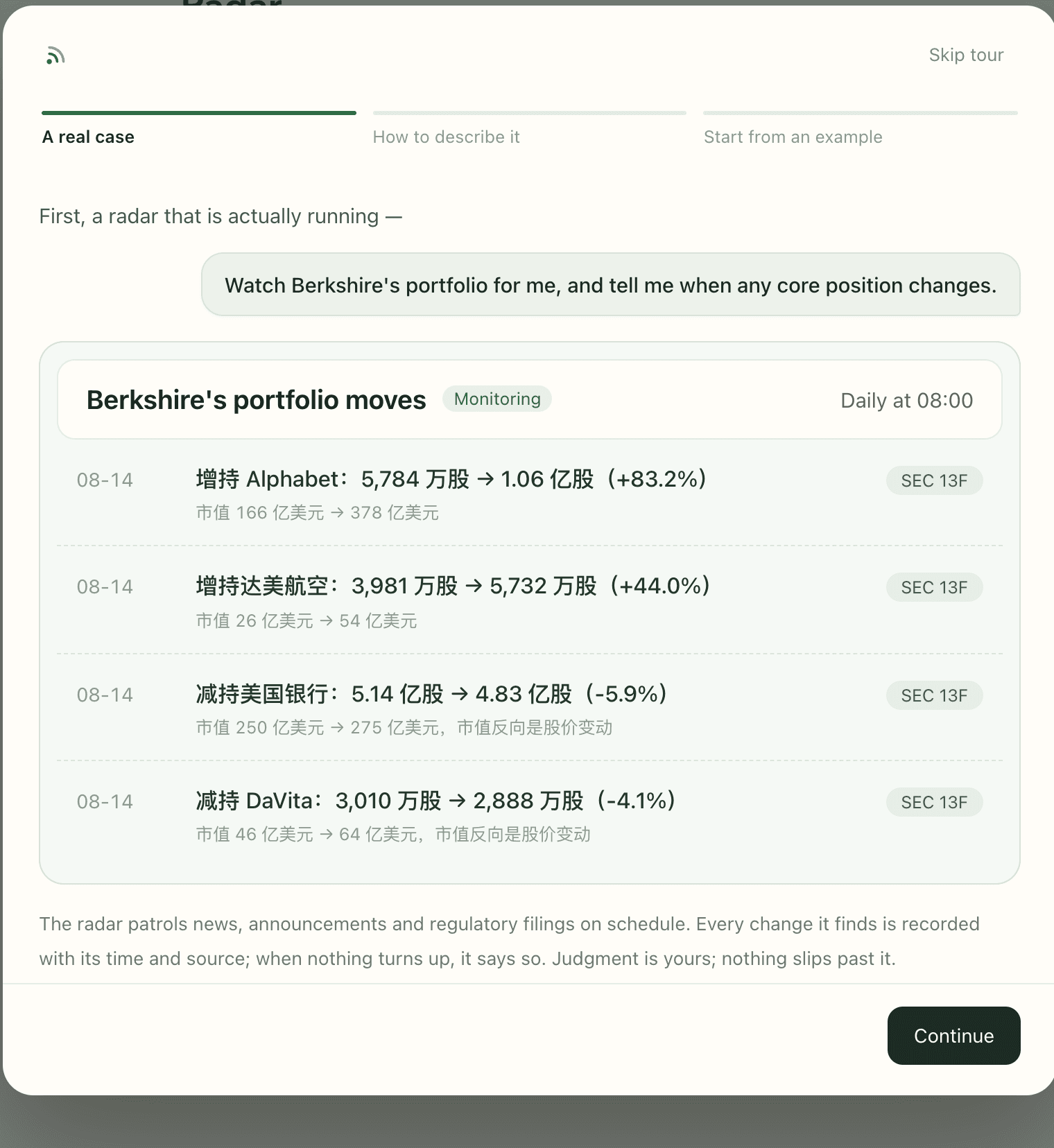
Hand it a company, a theme or an open question and it scans on your schedule. Quiet when nothing material changes; it reports what moved and why it matters.
- Watch companies, themes or conditions you write down, at a cadence you set.
- A hit comes with its full trail: when, what changed, and where the evidence is.
- An empty scan is reported as scanned-and-empty — silence never means it didn't run.
Investment framework
Write down your own standards and what would falsify a view. Research is checked against it, so each conclusion can be reviewed and carried forward.
- In your own words: what counts as good evidence, what makes you concede.
- Reading and research both pass through this standard; the AI answers inside your framework.
- Every conclusion keeps the evidence it stood on — traceable when wrong, compounding when right.
以合理价格买入优秀公司,胜过以便宜价格买入平庸公司。
It's far better to buy a wonderful company at a fair price than a fair company at a wonderful price.- The businessHow does it make money, and how long can the edge last?
- The boundaryWhere do I truly understand what is going on?
- The priceIf I am wrong, is there still a margin of safety?
Public research resources · No sign-in required
Explore AI businesses, the industry map, and investment tools.
Explore the AI 100 ranking, industry map, and 23 native investment tools directly on DisconfirmAI, without signing in.
AI 100
Explore the global AI company ranking and industry lists, with each company's position and ranking basis.
Explore module →02 / 03AI industry map
See how equity value is distributed across AI companies and industry layers; select a segment to explore.
Explore module →03 / 03AI investment tools
Move from business quality and selling pressure to valuation and disconfirmation. Use individual valuation templates and market dashboards when needed.
Explore module →Questions people ask
What does DisconfirmAI actually do?
Three things. It gathers the AI and investing items worth your time each day. When something catches your interest, you dig in with the original material. And once you have written a view down, new evidence comes back to test it, including the part that could overturn it.
How is this different from using ChatGPT?
DisconfirmAI connects public reading, saved material, research conversations and the companies you follow in one place. You can take a reading item into research, examine its sources and look for evidence that could change your view.
Will it recommend stocks or trade for me?
No. No buy or sell calls, no trade execution, no promised returns, no entry or exit levels. What you get is evidence, explanation, the other side, and the conditions worth checking. What you buy, when, and how much stays your decision.
Where does the content come from, and can I check it?
Reading is prepared from public sources through AI-assisted editing and a separate automated review. Articles link to their sources; source publication dates are distinct from the reading edition date. Research can examine filings and reports, but generated answers and automated checks can be wrong. Check the original material, dates and any stated gaps before relying on a conclusion.
How much time does it need each day?
Reading can be five to ten minutes a day, or twice a week if you let it pile up. Questions that genuinely deserve proper research come along a few times a month. There is no streak to maintain, and nothing is pushed just to get you to open the app: when nothing material has changed, it stays quiet.
Why do you keep talking about overturning a view?
Because a view is only worth trusting if it survives the attempt to break it. Conclusions state what the strongest evidence against them would be, and what to check next. That is what Disconfirm means: look for where you could be wrong before you talk about conviction.
Do I need an account, and does it cost anything?
Public reading, the reading library and open claims need no sign-in. Saving articles, following companies, personal research and long-term tracking need an account, which is one Google sign-in. The public parts are free at present.